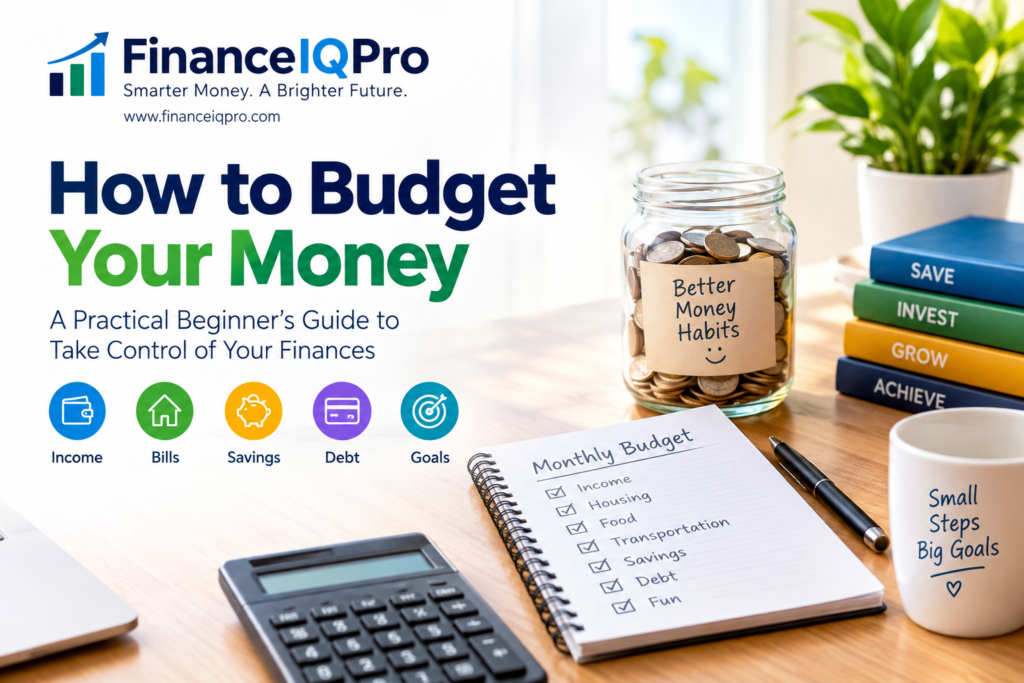
Learning how to budget is less about restricting every purchase and more about deciding where your money should go before you spend it. A useful budget tells you how much income is available, which expenses are unavoidable, how much you can reasonably save, and where discretionary spending needs to be adjusted.
Consumer.gov defines a budget as a written plan for deciding how to spend money each month. NerdWallet similarly describes budgeting as a way to manage bills, savings, debt, and other financial goals.
For a beginner, the hardest part is usually not creating a spreadsheet. It is creating a budget that reflects real life. Rent may increase, groceries fluctuate, car repairs appear unexpectedly, and annual expenses can make a monthly budget look better than it actually is.
This guide walks through a practical system for building a budget from your actual take home pay, handling irregular expenses, choosing a budgeting method, and adjusting the plan when the numbers do not work.
Start With Your Take Home Income
The first step in learning how to budget is determining how much money you actually have available to spend.
For most employees, this means starting with take home pay rather than gross salary. Take home pay is the amount that reaches your bank account after taxes and other payroll deductions.
For example, suppose a hypothetical employee earns $72,000 per year before taxes but receives $4,600 per month after taxes, health insurance, retirement contributions, and other payroll deductions. The starting point for the monthly spending plan is generally the $4,600 available to the household, not the $6,000 gross monthly salary.
If you have multiple income sources, include them separately. This could include:
- Regular employment income
- Self employment income
- Side gig income
- Commissions or bonuses
- Alimony or other recurring income
- Certain government benefits or other predictable payments
For irregular income, avoid assuming that your highest recent month will continue indefinitely. A conservative approach is to build the regular budget around dependable income and treat unusually high income as separate money until it is actually received.
NerdWallet’s current budgeting guidance also recommends using after tax income and accounting for deductions appropriately when determining the amount available for a budget.
The goal is simple: establish a realistic monthly number before deciding how much you can spend.
Track Where Your Money Is Actually Going
Before deciding that you spend too much on restaurants, shopping, subscriptions, or entertainment, look at the numbers.
Consumer.gov recommends gathering bills and pay information and listing expenses. NerdWallet also recommends reviewing recent spending rather than creating a budget entirely from estimates.
Review at least one month of spending. Ideally, examine three months because some expenses do not occur every month.
Separate expenses into categories such as:
| Category | Examples |
|---|---|
| Housing | Rent, mortgage, property taxes |
| Utilities | Electricity, water, gas, internet |
| Food | Groceries, restaurants, delivery |
| Transportation | Car payment, fuel, insurance, transit |
| Insurance | Health, auto, renters or homeowners |
| Debt | Credit cards, student loans, personal loans |
| Savings | Emergency fund, retirement, other goals |
| Discretionary | Entertainment, hobbies, shopping |
| Irregular | Repairs, gifts, annual subscriptions, travel |
Do not worry about making every category perfect on the first attempt.
The purpose of tracking is to discover the difference between what you think you spend and what you actually spend.
That difference is often where the most useful budgeting decisions begin.
Separate Needs, Wants and Financial Priorities
One of the simplest ways to organize a budget is to separate spending into needs, wants, and savings or debt priorities.
Needs are expenses that are necessary for basic living or maintaining important obligations. These can include housing, basic utilities, groceries, transportation required for work, insurance, and minimum debt payments.
Wants are discretionary expenses. Examples can include restaurant meals, entertainment, vacations, upgraded electronics, subscriptions, and nonessential shopping.
The third category includes financial priorities such as emergency savings, retirement contributions, investments, and debt payments above required minimums.
This distinction is useful because it gives you a decision framework when your budget does not balance.
Suppose your monthly take home income is $4,600 and your essential expenses total $3,100. You have $1,500 remaining before discretionary spending and additional financial goals.
If you are currently spending $1,200 on discretionary purchases and saving only $100, the problem is not necessarily that your income is too low. Your spending priorities may simply need to be rearranged.
On the other hand, if essential expenses already consume $4,300, cutting streaming subscriptions may have little effect. In that situation, the larger issue may involve housing, transportation, debt, insurance, or income.
A good budget therefore identifies the biggest financial pressures instead of automatically blaming small purchases.
Choose a Budgeting Method That Matches Your Situation
There is no requirement to use one particular budgeting system. The right method depends on your income, expenses, financial goals, and how much detail you are willing to track.
The 50/30/20 method is one popular starting point. It generally allocates up to 50% of take home income to needs, 30% to wants, and 20% to savings and debt repayment. NerdWallet and Forbes Advisor both describe variations of this framework while emphasizing that the percentages can be adjusted.
A zero based budget takes a different approach. Every dollar of income is assigned a purpose so that planned income minus planned expenses, savings, and debt payments equals zero.
The envelope method limits spending within specific categories, How To Make A Budget
cash envelopes or a digital equivalent.
A pay yourself first approach prioritizes savings before discretionary spending. Instead of saving whatever happens to remain at the end of the month, you automatically move a predetermined amount into savings or another financial account when income arrives.
Here is a practical comparison:
| Budget method | Main idea | Potential advantage | Potential drawback |
|---|---|---|---|
| 50/30/20 | Divide income into broad categories | Simple to understand | May not fit high cost households |
| Zero based | Give every dollar a job | Very detailed control | Requires more tracking |
| Envelope | Set limits for spending categories | Useful for controlling variable spending | Can require frequent monitoring |
| Pay yourself first | Save before spending | Makes saving automatic | Less detailed for controlling spending |
| Hybrid | Combine methods | Flexible and practical | Requires your own rules |
You do not have to follow a budgeting method exactly.
For example, someone living in a high cost area may find that housing alone makes the traditional 50% needs target unrealistic. NerdWallet specifically notes that budgeting percentages can be changed to fit individual circumstances.
The objective is not to achieve a perfect percentage. It is to create a spending system that remains financially workable.
Try the 50/30/20 Rule With Real Numbers
The 50/30/20 framework becomes easier to understand when you put actual numbers into it.
Consider this hypothetical example:
Monthly take home income: $5,000
A traditional 50/30/20 allocation would look like:
| Category | Percentage | Monthly amount |
|---|---|---|
| Needs | 50% | $2,500 |
| Wants | 30% | $1,500 |
| Savings/debt | 20% | $1,000 |
| Total | 100% | $5,000 |
Now suppose the person’s actual expenses are:
- Housing: $1,700
- Utilities: $250
- Groceries: $450
- Transportation: $350
- Insurance: $250
Total essential spending is $3,000, or 60% of take home income.
That household cannot realistically force its needs into $2,500 without making a significant change to housing, transportation, food, insurance, or another major expense.
Instead of treating the 50/30/20 rule as a failure test, the household could temporarily use a different structure.
For example:
- Needs: 60% = $3,000
- Wants: 20% = $1,000
- Savings/debt: 20% = $1,000
The important number is not whether the household perfectly follows a popular formula. It is whether the $5,000 is intentionally allocated and whether the resulting plan supports the household’s goals.
This is one reason percentage based budgets should be treated as frameworks rather than universal financial laws.
Build Savings Into the Budget Instead of Hoping for Leftovers
One of the most common budgeting mistakes is treating savings as whatever remains after everything else has been paid.
That can work in months when spending is unusually low, but it is unreliable.
A stronger approach is to create a savings category before discretionary spending is allocated.
Potential savings goals include:
- Emergency savings
- Retirement
- Home down payment
- Car replacement
- Education
- Travel
- Annual insurance premiums
- Major repairs
- Other planned purchases
Emergency savings deserve particular attention because unexpected expenses can otherwise force you to use credit cards or loans.
The exact emergency fund target depends on your income stability, household expenses, employment situation, insurance coverage, and other factors. There is no single dollar amount that works for every household.
Automation can make the process easier. NerdWallet’s current budgeting guidance recommends setting up automatic transfers to savings or investment accounts when appropriate.
For example, a hypothetical employee paid twice per month could automatically transfer $250 from each paycheck into a dedicated savings account. That produces $500 per month without requiring the person to remember to move the money manually.
The amount should be realistic. An automatic transfer that repeatedly causes an overdraft or forces you to use a credit card is not a successful budget.
Account for Irregular Expenses Before They Become Emergencies
A monthly budget can look perfectly balanced until a $900 car repair, $600 insurance bill, or $1,200 annual subscription appears.
These expenses are not necessarily emergencies. Many are predictable expenses that simply do not arrive every month.
A useful technique is to convert annual or irregular costs into monthly savings targets.
Suppose a hypothetical household expects:
- $1,200 in annual insurance premiums
- $600 in annual vehicle maintenance
- $800 in holiday and gift spending
- $1,000 in annual travel expenses
The total is $3,600.
Dividing $3,600 by 12 gives a monthly set aside of $300.
Instead of waiting for each bill to arrive, the household could budget $300 per month toward these irregular expenses.
This creates a sinking fund system.
Sinking funds can be especially useful for expenses that are predictable but infrequent. They prevent a budget from appearing healthy simply because an annual expense happens to fall outside the current month.
This is also why reviewing only one month of transactions can be misleading. A three month review combined with an annual expense list gives you a much clearer picture of the actual cost of living.
Make Debt Payments Part of the Budget
Debt should not be treated as an afterthought.
At minimum, your budget needs to account for required payments on credit cards, student loans, auto loans, mortgages, and other debts.
After minimum payments are covered, you can decide whether additional cash should go toward debt reduction, savings, investing, or another financial priority.
If you have high interest credit card debt, the interest cost can make carrying a balance particularly expensive. Paying more than the minimum can reduce the principal faster, although the appropriate strategy depends on the interest rates, balances, and other financial obligations involved.
Two common approaches are:
- Debt avalanche: prioritize the debt with the highest interest rate.
- Debt snowball: prioritize the smallest balance first.
The avalanche method can reduce interest costs mathematically when all other factors are equal, while the snowball method can provide a clearer short term milestone by eliminating smaller balances first.
A budget should make the choice visible.
For example, if you have $600 available after essential expenses and minimum payments, you could explicitly allocate $400 toward additional debt repayment and $200 toward a specific savings goal rather than letting the $600 disappear into unplanned spending.
Use Your Budget to Make Better Spending Decisions
A budget becomes useful when it changes decisions before money is spent.
Suppose you have $300 remaining in your restaurant and entertainment category for the month and are considering a $180 dinner.
The relevant question is not simply, “Can I afford $180?”
The better question is, “If I spend $180, will the remaining $120 be enough for the rest of the month?”
That shift turns a budget from a record keeping exercise into a decision making tool.
The same principle applies to large purchases.
Before financing a $35,000 vehicle, for example, look beyond the advertised monthly payment. Consider the total cost of the vehicle, including the payment, insurance, fuel, maintenance, registration, taxes, and financing costs.
A $550 monthly car payment may appear affordable by itself but become much more expensive when the full transportation category is considered.
Budgeting therefore works best when categories reflect total financial impact rather than isolated bills.
Review and Adjust the Budget Every Month
A budget should change when your financial circumstances change.
Rent can increase. Insurance premiums can change. A loan can be paid off. Income can rise or fall. A new child can increase household expenses. A job change can alter commuting costs.
For that reason, budgeting is not a one time task.
Consumer.gov provides a budget worksheet based on listing income and expenses, while NerdWallet recommends regularly reviewing and adjusting a budget rather than treating the initial plan as permanent.
A practical monthly review can take 20 30 minutes.
Check:
- Actual income versus planned income
- Housing and utility costs
- Grocery spending
- Transportation
- Debt payments
- Savings contributions
- Discretionary spending
- Upcoming irregular expenses
- Progress toward financial goals
Then make one or two changes for the next month.
Do not attempt to redesign every category every time. If groceries were $75 above target, determine why. If dining out was $250 higher than expected, decide whether the category needs a higher limit or whether spending needs to be reduced.
The objective is continuous adjustment rather than perfection.
What to Do When Your Budget Does Not Balance
Sometimes the problem is not poor spending discipline. The numbers genuinely do not work.
If monthly take home income is $4,000 and necessary expenses are $4,300, cutting $20 from entertainment will not solve the underlying problem.
Start with the largest flexible expenses.
Housing, transportation, debt payments, insurance, and food can have much greater effects than eliminating a few inexpensive subscriptions.
Consider whether you can:
- Reduce a major recurring expense
- Refinance or restructure eligible debt after comparing costs
- Change insurance coverage or shop competing policies
- Reduce transportation costs
- Lower discretionary spending
- Increase work hours or income
- Add a sustainable side income source
- Delay a nonessential purchase
- Reprioritize savings temporarily
Be careful with solutions that create a different problem. Using credit cards to cover recurring budget deficits, for example, can shift today’s cash flow problem into future interest costs.
If income is temporarily low, the budget may need to prioritize essential expenses and minimum debt obligations until the situation changes.
If expenses remain structurally higher than income, the budget is doing its job by showing you that something larger needs to change.
Create a Simple Monthly Budget You Can Actually Maintain
You do not need an elaborate spreadsheet to start.
A simple monthly structure could look like this:
| Monthly budget | Amount |
|---|---|
| Take home income | $5,000 |
| Housing | $1,700 |
| Utilities | $250 |
| Groceries | $500 |
| Transportation | $400 |
| Insurance | $250 |
| Minimum debt payments | $300 |
| Savings | $700 |
| Extra debt repayment | $300 |
| Wants/discretionary spending | $600 |
| Total planned spending | $5,000 |
This is a hypothetical example, not a recommended allocation for every household.
The value of this format is that every dollar has a destination. If actual spending consistently differs from the plan, you can determine whether the budget needs adjustment or whether spending behavior needs to change.
If you prefer more detail, divide categories further. If you hate spreadsheets, use a notebook or a budgeting app. The best system is generally the one you can maintain consistently.
A sophisticated budget that you abandon after two weeks is less useful than a simple budget you review every month.
Conclusion
Learning how to budget is fundamentally about creating a realistic plan for your income before the money disappears.Start with take-home income, examine actual spending, separate essential costs from discretionary purchases, choose a budgeting framework, create savings and debt categories, and account for irregular expenses. Then review the results regularly and adjust the plan when your circumstances change.
FAQs
What is the easiest way to start a budget?
Start by calculating your monthly take home income and reviewing your recent bank and credit card transactions. List your fixed expenses, variable expenses, debt payments, savings, and discretionary spending. Then compare your total planned expenses with your income.
How much money should I save each month?
There is no universal amount that applies to every household. Your savings target depends on income, essential expenses, debt, emergency fund needs, retirement goals, and other priorities. A useful approach is to choose a realistic amount that can be transferred consistently without creating a cash flow problem.
Is the 50/30/20 rule still useful?
Yes, it can be a useful starting framework, but the percentages are not mandatory. The traditional framework assigns 50% of take home income to needs, 30% to wants, and 20% to savings and debt repayment. Households with different circumstances may need to modify those percentages.
Should I budget using gross income or take home pay?
For a household spending budget, take home pay is generally the more practical starting point because it represents the money actually available after payroll deductions. If you also want to analyze retirement contributions or other payroll deductions, track those separately so you understand your total compensation and savings.
How do I budget with irregular income?
Base essential spending on a conservative estimate of dependable income rather than your highest earning month. Keep a larger cash buffer when possible, separate business expenses and taxes from personal spending if you are self employed, and adjust discretionary spending when income changes.
What expenses should be included in a monthly budget?
Include housing, utilities, groceries, transportation, insurance, debt payments, savings, subscriptions, entertainment, personal spending, and irregular expenses. Annual expenses should also be converted into monthly savings targets so they do not unexpectedly disrupt your budget.
How do I budget when I have credit card debt?
First account for required minimum payments. Then determine how much additional money can realistically go toward debt after essential expenses and an appropriate savings buffer. You can compare a debt avalanche strategy, which prioritizes higher interest debt, with a debt snowball strategy, which prioritizes smaller balances.
Should savings be included as an expense?
For budgeting purposes, treating planned savings as a required allocation can make saving more consistent. Instead of waiting to see what remains at the end of the month, include savings in the initial spending plan and automate transfers when practical.
What if my expenses are higher than my income?
First verify that all income and expenses have been recorded accurately. Then identify the largest expenses rather than focusing only on small purchases. You may need to reduce recurring costs, increase income, change debt priorities, or temporarily reduce discretionary spending. Repeatedly covering a budget deficit with credit can create additional interest costs.
How often should I review my budget?
A monthly review is a practical starting point. Compare planned amounts with actual spending, identify categories that consistently differ, and adjust the following month’s plan. A more detailed review every few months can help identify longer term changes in income, expenses, debt, and savings progress.


What Is Personal Finance A Practical Guide to Managing Money
Sep 28, 2026 at 4:57 pm[…] identifies five broad areas: income, spending, saving, investing, and protection. Those categories provide a useful framework, but personal finance is ultimately about making decisions within your own […]